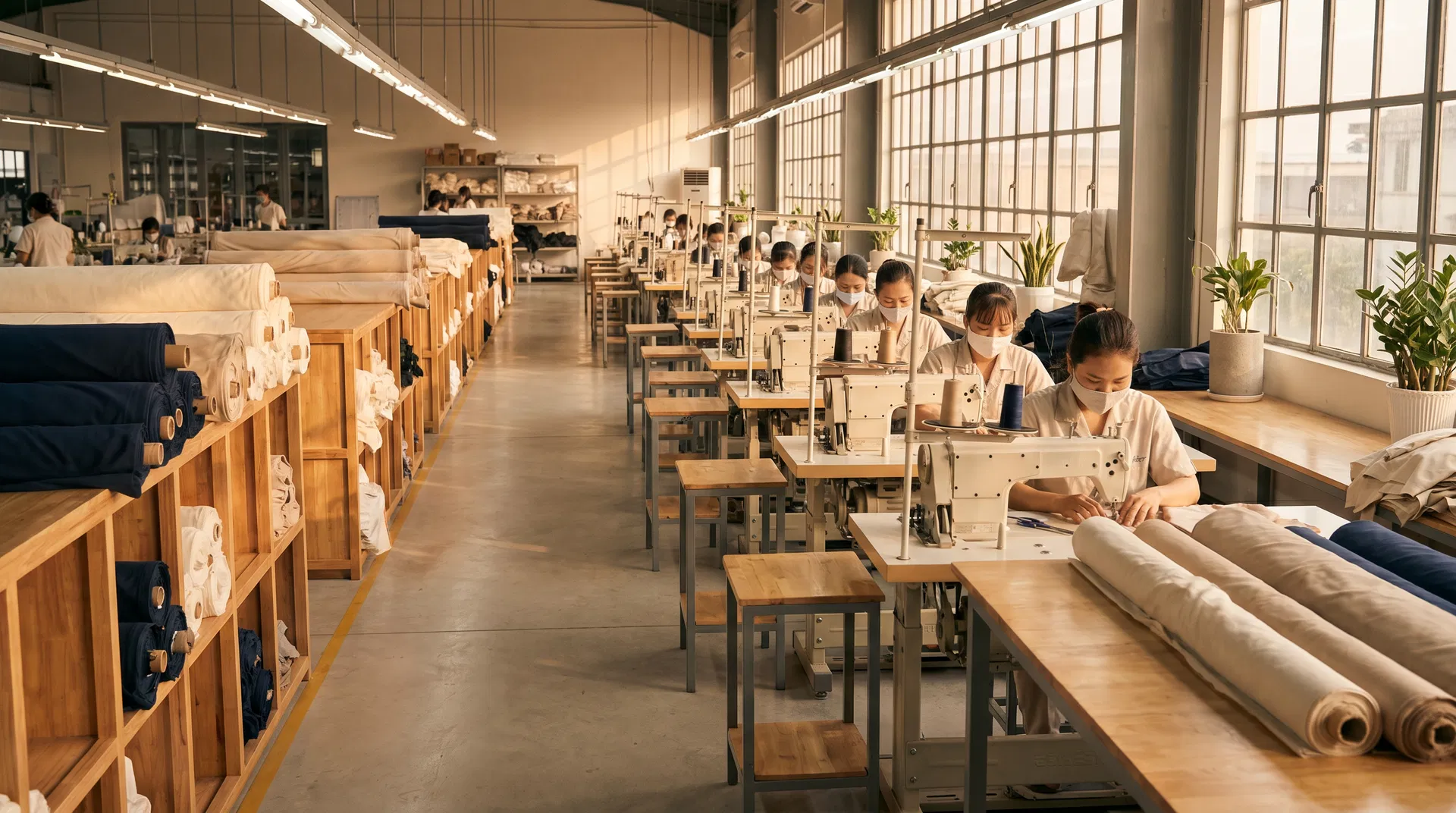
Why Vietnam Is on Every Sourcing Director's Radar
Vietnam has undergone a remarkable transformation over the past two decades. Once a secondary option for brands seeking alternatives to China, it is now the world's third-largest apparel exporter, shipping over $40 billion USD in garments annually. The country's rise has been driven by a combination of competitive labour costs, improving factory infrastructure, and a government actively courting foreign investment in the textile and apparel sector.
For Canadian brands in particular, Vietnam offers a compelling value proposition: skilled craftsmanship, reliable production timelines, and a growing base of certified factories that meet the compliance standards required by North American and European retailers.
What Vietnam Does Best
Vietnam's manufacturing strengths are concentrated in specific product categories, and understanding this is critical to making the right sourcing decision.
| Category | Vietnam Strength | Notes |
|---|---|---|
| Woven Garments | Excellent | Dress shirts, chinos, structured outerwear |
| Outerwear | Excellent | Jackets, parkas, technical shells |
| Workwear | Very Good | Uniforms, safety apparel, durable bottoms |
| Technical Apparel | Growing | Performance fabrics, bonded constructions |
| Knitwear & Basics | Moderate | Less competitive than Bangladesh on price |
| Activewear | Moderate | Growing capacity, but Bangladesh leads on volume |
If your brand focuses on structured woven garments, outerwear, or workwear, Vietnam should be near the top of your sourcing shortlist. For high-volume knitwear and basics, Bangladesh typically offers better pricing and faster scale.
Minimum Order Quantities and Pricing
Vietnam factories generally operate at a mid-range price point — higher than Bangladesh, lower than most Chinese facilities for equivalent quality. Expect the following benchmarks:
- MOQ: 300–1,000 units per style is typical for established factories. Some smaller, more flexible facilities will work with 200-unit minimums for repeat clients.
- Pricing: Woven shirts and bottoms typically range from $8–$18 USD FOB depending on complexity, fabric, and finish. Technical outerwear can range from $25–$65 USD FOB.
- Sample costs: Most factories charge $50–$150 USD per sample, credited back on bulk orders.
These figures vary significantly by factory tier, product complexity, and order volume. loomlink works with vetted facilities across Vietnam and can provide accurate pricing benchmarks for your specific product requirements.
Lead Times
Vietnam's production timelines are generally reliable, though longer than Bangladesh for simple knitwear:
| Stage | Typical Duration |
|---|---|
| Sample development | 2–3 weeks |
| Bulk production (first order) | 60–90 days after sample approval |
| Bulk production (repeat order) | 45–60 days |
| Shipping to Canada (sea freight) | 18–22 days |
Planning a 4–5 month runway from initial brief to landed goods is a reasonable baseline for first-time Vietnam orders.
Certifications and Compliance
Vietnam's factory ecosystem has matured significantly in terms of compliance infrastructure. The following certifications are widely available:
- WRAP (Worldwide Responsible Accredited Production) — the most common social compliance certification
- BSCI (Business Social Compliance Initiative) — required by many European and Canadian retailers
- OEKO-TEX Standard 100 — for chemical safety in finished garments and fabrics
- ISO 9001 — quality management systems
- GRS (Global Recycled Standard) — for brands with recycled content requirements
When sourcing through loomlink, factory compliance documentation is verified before any order is placed, and audit reports are available on request.
Key Challenges to Understand
Vietnam is not without its sourcing challenges. Being aware of these upfront helps you plan accordingly:
Labour costs are rising. Vietnam's minimum wage has increased steadily over the past decade, and while it remains competitive, the cost advantage over Bangladesh has narrowed. For price-sensitive basics, Bangladesh often wins on landed cost.
Factory scale is smaller. Most Vietnamese factories are mid-sized operations (500–3,000 workers) compared to the mega-factories in Bangladesh. This means Vietnam is better suited to brands with moderate volumes rather than those placing 100,000+ unit orders.
Fabric sourcing is partially import-dependent. Vietnam imports a significant portion of its fabric from China and South Korea. This can create lead time and cost variability, particularly for specialty fabrics. Working with a sourcing partner who manages the supply chain end-to-end helps mitigate this risk.
Language and communication. English proficiency varies widely across factories. Direct communication without a local partner can lead to misunderstandings on technical specifications. loomlink's on-the-ground relationships ensure specifications are communicated accurately.
How loomlink Sources from Vietnam
loomlink maintains direct relationships with a curated network of vetted Vietnamese factories, focused on outerwear, woven garments, and workwear. Our sourcing process for Vietnam orders includes:
- Factory matching — we identify the right facility based on your product category, volume, and compliance requirements
- Technical package review — we review your tech pack or help develop one before factory submission
- Sample coordination — we manage the sampling process, including fit reviews and revision rounds
- Pre-production approval — fabric and trim approvals are confirmed before bulk cutting begins
- In-line and final inspection — quality checks are conducted during and after production
- Logistics coordination — we manage freight forwarding, customs documentation, and delivery to your warehouse
The result is a fully managed sourcing experience — you stay focused on your brand while we handle the factory relationship.
Is Vietnam Right for Your Brand?
Vietnam is an excellent sourcing destination if your brand meets one or more of the following criteria:
- You produce structured woven garments, outerwear, or workwear
- You value compliance and certification documentation
- Your order volumes are in the 500–10,000 unit range per style
- You are looking to diversify your supply chain away from a single country
- You need a reliable partner for consistent repeat production
If you are primarily producing high-volume knitwear or activewear basics, Bangladesh may offer better economics. loomlink sources from both countries and can help you determine the right mix for your product line.
Ready to explore Vietnam sourcing for your brand? Book a consultation with the loomlink team and we will assess your product requirements, provide factory options, and give you an honest cost comparison across our sourcing network.